
Spy Gear and Surveillance Equipment for Private Investigators
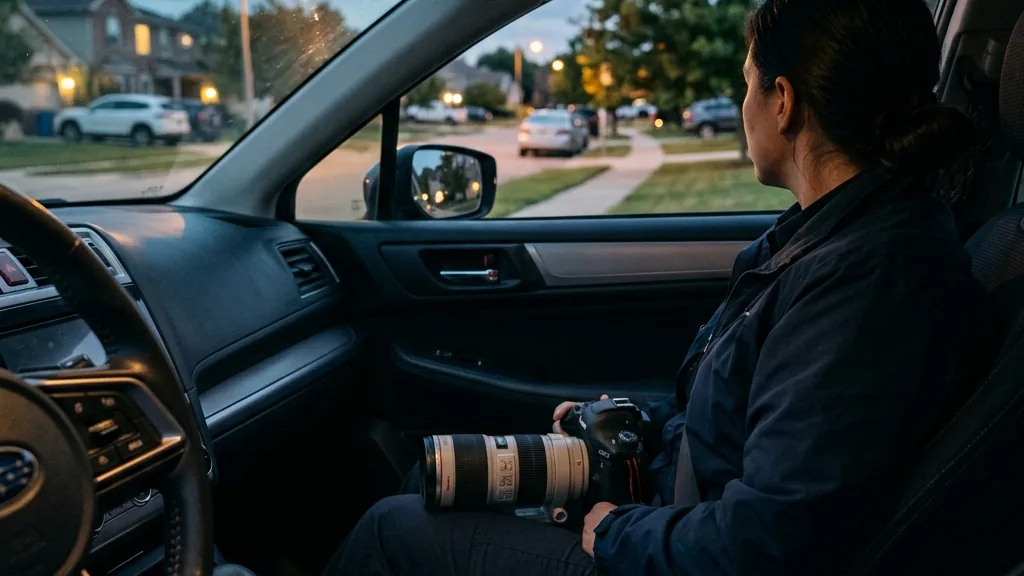
Walk into any spy shop or browse Amazon for "spy gear" and you will find thousands of gadgets marketed with dramatic language and promises of covert capability. Most of it is consumer-grade junk.
Professional surveillance equipment should be selected for lawful documentation, clear imagery, and safe operation. This guide covers common equipment categories, typical costs, and legal boundaries to understand before using any of it.
1. Cameras and Video Equipment
The camera is the single most important piece of equipment an investigator owns. Everything else supports the camera's job: capturing clear, timestamped, court-admissible visual evidence.
DSLR and Mirrorless Cameras
For most surveillance work, a DSLR or mirrorless camera with a 70-300mm telephoto lens is the standard. These cameras produce high-resolution images at distances up to several hundred feet. Look for models with fast autofocus, good low-light performance (high ISO capability), and silent shooting modes. Canon and Nikon dominate the PI market, though Sony mirrorless bodies are gaining ground due to their compact size and excellent autofocus systems.
Bridge Cameras
Bridge cameras like the Nikon Coolpix P1000 offer extreme zoom ranges (up to 125x optical) in a single body. They lack the image quality of a DSLR with a professional lens, but they let you capture identifiable images from extraordinary distances. Many investigators keep a bridge camera as a backup for situations where a DSLR with a large lens would be too conspicuous.
HD Camcorders
When you need continuous video recording rather than still photos, a dedicated camcorder with optical image stabilization is the right choice. Modern 4K camcorders produce clear video with embedded timestamps. The timestamp is critical for court admissibility. If your video does not have a continuous, visible timestamp, its evidentiary value drops significantly.
2. Covert Recording Devices
Sometimes you need to record without the camera being visible. Covert cameras are designed to look like ordinary objects while capturing video evidence.
Body-Worn Cameras
Cameras disguised as pens, buttons, eyeglasses, key fobs, and badge holders allow investigators to record interactions hands-free. Quality varies dramatically. Brands like LawMate produce reliable, law-enforcement-grade covert cameras with good video quality and reasonable battery life. Cheap alternatives from unknown brands often produce blurry footage with poor audio.
Stationary Covert Cameras
Cameras disguised as alarm clocks, phone chargers, smoke detectors, and other household objects can record activity in a specific location. These are useful for documenting activity in a client's own property, such as monitoring a nanny or verifying employee behavior in a workplace (where the employer owns the premises and has legal authority to monitor).
Important: Covert recording is heavily regulated. You generally cannot place cameras in locations where people have a reasonable expectation of privacy (bathrooms, bedrooms in someone else's home). The camera owner typically needs legal authority over the space being monitored. Always consult the legal boundaries of PI work before deploying covert cameras.
3. GPS Tracking Equipment
GPS trackers monitor a vehicle's location in real time. They are one of the most powerful surveillance tools available, but also one of the most legally restricted.
How PI GPS Trackers Work
Professional-grade GPS trackers attach magnetically to a vehicle's undercarriage and transmit location data via cellular networks to a monitoring platform. They report location, speed, direction, and stop durations. Some models include geofencing alerts that notify you when the vehicle enters or leaves a defined area. Battery life ranges from several days to several months depending on the device and reporting frequency.
GPS Legal Restrictions
GPS tracking is one of the most legally complex areas of PI work. The rules differ by state:
- California: Generally illegal to track someone without consent (Penal Code 637.7). Vehicle owners can track their own vehicles.
- Texas: Illegal to install a tracker on another person's vehicle without consent (Penal Code 16.06).
- New York: No specific GPS tracking statute, but courts have addressed it under privacy laws.
- Florida: Statute 934.425 prohibits installing tracking devices without consent.
Because of these restrictions, GPS trackers are most commonly used when the client legally owns or co-owns the vehicle being tracked. Read our state-by-state licensing guide for more on state-specific regulations.
4. Night Vision and Low-Light Equipment
Many surveillance operations continue after dark. Without proper equipment, nighttime surveillance produces unusable evidence.
Night Vision Monoculars and Binoculars
Generation 2 (Gen 2) and Generation 3 (Gen 3) night vision devices amplify ambient light to produce a visible image in near-total darkness. Gen 2 devices typically cost $1,500 to $3,000 and work well for most PI applications. Gen 3 devices offer superior clarity and range but cost $3,000 to $6,000 or more. Gen 1 devices are significantly cheaper but produce grainy images with limited range.
Infrared Cameras
IR-capable camcorders and DSLR cameras use infrared illuminators to light a scene invisibly. The IR light is invisible to the human eye but shows up clearly on camera. This allows you to record video in complete darkness without alerting the subject. The trade-off is that IR footage appears in monochrome (black and white or green-tinted).
Thermal Imaging
Thermal cameras detect heat signatures rather than visible or infrared light. They work in complete darkness, through fog, and can detect people behind thin barriers. FLIR makes compact thermal cameras that attach to smartphones, starting around $400. Dedicated thermal monoculars from Pulsar and FLIR range from $1,500 to $5,000.
5. Counter-Surveillance and TSCM Equipment
TSCM (Technical Surveillance Countermeasures) is the other side of the equation. Instead of watching someone, you are checking whether someone is watching your client.
RF Detectors
Radio frequency detectors scan for wireless transmissions from hidden cameras, audio bugs, and GPS trackers. Professional units like the REI OSCOR sweep multiple frequency bands simultaneously. Consumer-grade RF detectors cost $50 to $200 and catch basic wireless devices. Professional units run $5,000 to $30,000 and detect a much wider range of surveillance equipment.
Non-Linear Junction Detectors (NLJDs)
NLJDs find electronic components even when they are powered off. They work by transmitting a signal and analyzing the harmonic response from semiconductor junctions. This makes them effective against devices designed to evade RF detection by staying dormant until activated.
Lens Detectors
These devices use infrared light to detect camera lenses. When the IR beam hits a lens, it reflects back with a distinctive sparkle visible through the detector's viewfinder. They are useful for quickly scanning a room for hidden cameras.
6. Vehicle and Field Equipment
Surveillance Vehicles
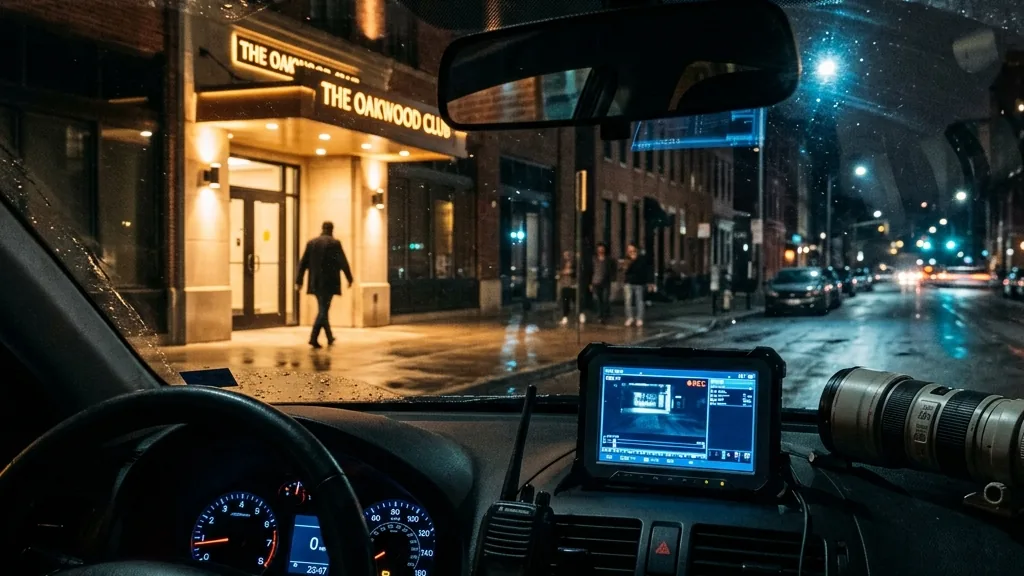
The best surveillance vehicle is the one nobody notices. Common, neutral-colored sedans and SUVs blend into most environments. Many investigators use minivans because they offer interior space to work, tinted rear windows for concealment, and they blend into suburban neighborhoods. Vehicle modifications include tinted windows, dashcam systems, power inverters for charging equipment, and window mounts for cameras.
Supporting Gear
- High-quality binoculars: 8x42 or 10x42 with good light transmission for observation
- Power inverter: Converts vehicle 12V power to 110V AC for charging equipment during long stakeouts
- Portable battery packs: Keep cameras, phones, and laptops charged during extended operations
- Notebooks and voice recorder: Document observations in real time with timestamps
- Changes of clothing: Alter appearance during multi-day surveillance operations
- Food and water: A stakeout can last 12 hours or more. Stay fueled without breaking position
7. Legal Boundaries for Surveillance Equipment
Owning surveillance equipment is legal. How you use it determines whether you are operating within the law. The key principles:
- Public vs. private space: You can photograph and video record anything visible from a public location. You cannot place cameras inside private spaces without authorization.
- Audio recording consent: Some states require all parties to consent to audio recording (two-party consent). Others only require one party to consent. Know your state's law.
- GPS tracking: Generally requires consent or ownership of the tracked vehicle. State laws vary significantly.
- No hacking or unauthorized access: No breaking into phones, computers, email accounts, or social media profiles. Ever.
- No trespassing: You cannot enter private property to place equipment or conduct observation.
Read our complete guide on what private investigators can legally do for detailed state-by-state information.
8. Building Your Equipment Kit
You do not need to buy everything at once. Here is a practical progression:
| Level | Equipment | Estimated Cost |
|---|---|---|
| Starter | DSLR + telephoto lens, binoculars, dashcam, notepad | $1,500 - $2,500 |
| Intermediate | Add: covert body camera, bridge camera, IR camcorder | $3,000 - $5,000 |
| Professional | Add: Gen 2 night vision, RF detector, GPS tracking kit | $8,000 - $15,000 |
| Full Service | Add: thermal imaging, NLJD, Maltego license, drone | $15,000 - $30,000+ |
The most important investment is not equipment. It is training. A $500 camera in the hands of an experienced investigator produces better evidence than a $5,000 camera operated by someone who does not understand surveillance craft, legal boundaries, and evidence handling.
If you need professional surveillance for your case, contact a qualified provider. We bring the right equipment, the right training, and the legal knowledge to produce results that hold up. You can also read about investigation costs or learn how to hire a PI.
Surveillance Equipment FAQ
Most PIs use DSLR or mirrorless cameras with 70-300mm telephoto lenses for daytime work. Some prefer bridge cameras with 50x or higher optical zoom for extended range. For covert situations, body-worn cameras disguised as pens, buttons, or glasses are common. The camera choice depends on the environment, distance, and whether the investigator needs to remain concealed.
GPS tracking laws vary significantly by state. In many states, a vehicle owner can place a tracker on their own vehicle. However, placing a tracker on someone else vehicle without their knowledge is illegal in most jurisdictions. States like California (Penal Code 637.7) and Texas (Penal Code 16.06) have specific statutes restricting GPS use. Always consult a licensed PI who understands your state laws.
Professional investigators use Generation 2 or Generation 3 night vision monoculars and binoculars for observation. For recording, infrared-capable camcorders and DSLR cameras with IR illuminators capture usable footage in near-total darkness. Thermal imaging cameras detect heat signatures and work in complete darkness, fog, and through some concealment.
Entry-level professional surveillance kits start around $2,000 to $3,000 and include a good camera with telephoto lens, basic covert camera, and observation tools. A full professional loadout with night vision, GPS equipment, counter-surveillance gear, and multiple cameras can run $10,000 to $25,000 or more. Most firms build their equipment inventory over time.
Most surveillance equipment is available for civilian purchase. Cameras, binoculars, dash cams, and night vision devices are widely sold. However, certain items like wiretapping equipment and some GPS trackers are restricted by law. More importantly, using surveillance equipment without understanding the legal boundaries can result in criminal charges. The equipment is legal; how you use it determines legality.
RF (radio frequency) detectors scan for wireless cameras and audio transmitters. Non-linear junction detectors (NLJDs) find electronic devices even when powered off. Lens detectors use infrared light to identify camera lenses. Thermal cameras can spot devices generating heat. Professional TSCM sweeps combine multiple detection methods for comprehensive coverage.
Need Professional Surveillance
Send an email inquiry with a non-sensitive summary, jurisdiction, timeline, and documentation needs.
Private inquiry - No obligation - Email only