
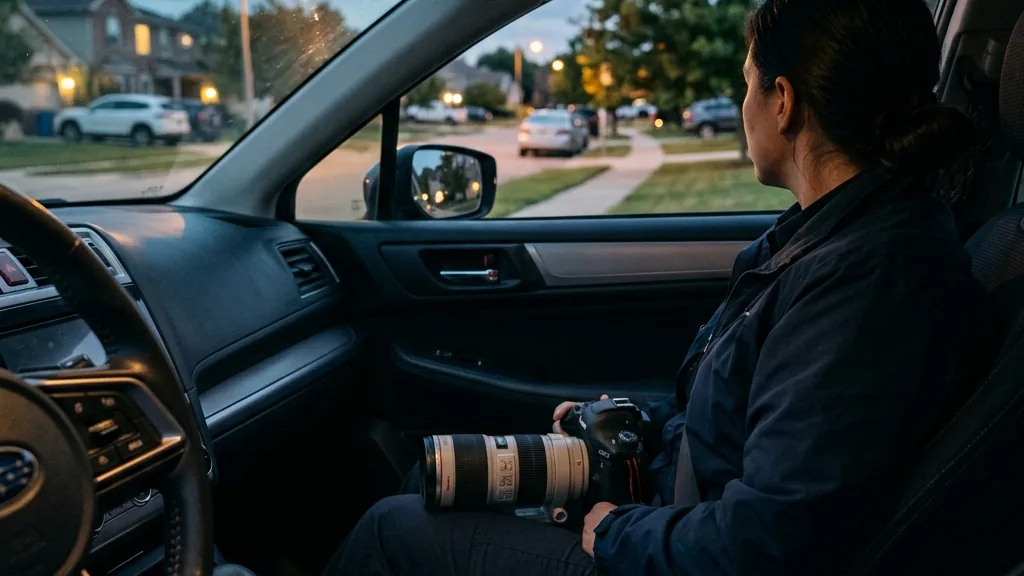
Surveillance Private Investigator: Discreet, Legal Evidence Gathering
When you need factual proof of someone's activities, a professional surveillance investigation can deliver documented evidence gathered legally and organized for attorney review.
What Is Professional Surveillance Investigation?
Surveillance is the systematic, covert observation and documentation of a subject's activities, movements, and interactions. It is one of the most powerful tools available to a licensed private investigator and forms the backbone of many investigation types. When you need factual, objective proof of what someone is doing, who they are meeting, or where they are going, physical surveillance is often the only way to obtain court-admissible evidence.
Unlike what you see in movies or television shows, real surveillance work requires extraordinary patience, methodical planning, and a deep understanding of privacy laws. Qualified investigators position themselves in public areas, use professional-grade cameras and recording equipment, and document observations with precision. Every photograph must be timestamped, and every observation must be meticulously logged to establish a clear chain of custody.
Professional surveillance matters because it provides objective, third-party evidence that carries far more weight than personal suspicions, hearsay, or secondhand accounts. Whether the evidence is used in family court during a custody battle, in civil litigation to prove insurance fraud, or simply for your own peace of mind in a personal relationship, it represents verified facts rather than speculation.
Who Needs Surveillance Investigation Services?
Surveillance investigation serves a wide range of clients and situations. Because it is highly adaptable, it is utilized by individuals, legal professionals, and corporations alike:
- Individuals suspecting infidelity: Documenting a partner's activities when trust has been broken. This provides peace of mind or necessary evidence for divorce proceedings. Learn more about infidelity investigation services.
- Attorneys preparing for trial: Gathering visual evidence of behavior, activities, or physical conditions relevant to legal proceedings. This is especially common in personal injury and liability cases.
- Parents in custody disputes: Observing and documenting the other parent's behavior, living conditions, associates, and childcare practices for child custody cases to ensure the child's safety and well-being.
- Insurance companies investigating claims: Verifying disability, personal injury, or workers' compensation claims. Surveillance can prove whether an individual claiming total disability is secretly working or engaging in strenuous physical activities.
- Businesses investigating employee misconduct: Documenting policy violations, intellectual property theft, embezzlement, or other workplace issues as part of comprehensive corporate investigations.
- Individuals concerned about personal safety: Monitoring potential stalking, harassment, or threatening behavior to build a case for a restraining order or police intervention.
The Step-by-Step Surveillance Process
A professional surveillance operation is not a random drive-by; it is a structured, tactical process. Here is what you can expect when you hire a licensed investigator:
Step 1: The Initial Consultation and Strategy
Before any field work begins, the investigator will conduct a thorough intake interview. You will be asked to provide detailed information about the subject: physical descriptions, vehicle makes and license plates, daily routines, known associates, and specific habits. The investigator will use this data to determine the best times and locations to initiate surveillance, minimizing wasted hours.
Step 2: Pre-Surveillance Reconnaissance
Investigators rarely go into a location blind. They will often conduct digital reconnaissance using OSINT tools to map the subject's neighborhood, identify exits, locate dead ends, and plan multiple observation points. This ensures they can maintain visual contact without being burned (discovered).
Step 3: Active Field Surveillance
This is the core of the investigation. The investigator will arrive at the location early and establish a covert vantage point. They will document the subject's departure, follow them in an unmarked vehicle, and observe their activities at various destinations. Investigators must constantly balance the need to get clear, identifying footage with the necessity of remaining completely undetected.
Step 4: Continuous Documentation
Surveillance is useless without proof. Throughout the operation, the investigator will capture high-resolution, timestamped video and photographs. Simultaneously, they maintain a written or dictated log detailing exact times, locations, and actions. This log becomes the foundation of the final report.
Step 5: The Final Report and Evidence Delivery
At the conclusion of the case, the investigator compiles a comprehensive written report. This document details the timeline of events, supported by the video and photographic evidence. A well-written report is objective, factual, and devoid of personal opinion—designed specifically to withstand scrutiny in a court of law.
Surveillance Methods and Professional Equipment
Qualified investigators use professional equipment and proven techniques to gather clear, usable evidence while remaining undetected. An amateur with a smartphone cannot replicate these results:
- Long-range telephoto cameras: Essential for discreet photography from safe distances, allowing the investigator to capture facial features or license plates from hundreds of feet away.
- Covert video systems: Hidden cameras built into everyday objects (like keys or buttons) for capturing interactions in public spaces like restaurants or stores.
- Specially equipped vehicles: Unmarked, customized surveillance vehicles with tinted windows, blackout curtains, and specialized power supplies for extended observation periods.
- Night-vision and low-light technology: Critical for after-dark observation, ensuring evidence is captured regardless of lighting conditions.
- GPS tracking devices: Used only where legally authorized by the vehicle owner or by a specific court order, aiding in maintaining contact during difficult mobile surveillance.
- Multi-investigator teams: For complex or high-risk cases, multiple investigators coordinate to prevent the subject from noticing the same vehicle following them.
Legal Boundaries of Surveillance: What PIs Can and Cannot Do
Understanding what a private investigator can legally do during surveillance is absolutely critical. Evidence obtained illegally is inadmissible in court and can result in civil or criminal liability for both the investigator and the client.
What is Legal:
- Observing a subject in any public place (parks, streets, shopping centers).
- Photographing or video recording a subject from a public area where there is no "reasonable expectation of privacy."
- Following a subject's vehicle on public roadways.
- Conducting "trash pulls" (searching abandoned trash placed on a public curb), though local ordinances occasionally restrict this.
What is NOT Legal:
- Trespassing on private property to look into windows or install cameras.
- Using hidden cameras inside a private residence without the owner's explicit consent.
- Wiretapping phones, intercepting digital communications, or hacking into email accounts.
- Impersonating law enforcement officers or government officials to gain access or information.
- Placing a GPS tracker on a vehicle without the legal owner's consent (laws on this vary significantly by state).
Surveillance Costs and Retainers
Understanding the cost of hiring a private investigator for surveillance helps you plan your budget effectively. Surveillance is inherently labor-intensive and is usually billed at an hourly rate.
Typical Hourly Rates: Across the USA, standard surveillance rates range from $75 to $150 per hour, per investigator. Rates fluctuate based on geographic location, the investigator's experience, and the danger level of the assignment.
Mileage and Expenses: In addition to the hourly rate, investigators typically charge for mileage (usually between $0.65 and $1.00 per mile) and pass along any necessary case expenses, such as tolls, parking fees, or admission tickets required to follow a subject into a venue.
Retainers: Almost all reputable agencies require an upfront retainer before initiating surveillance. For a standard 2-to-3-day surveillance operation, expect to pay a retainer of $1,500 to $3,500. The investigator bills their hourly rate and expenses against this retainer, refunding any unused portion at the conclusion of the case.
Red Flags to Watch For When Hiring a Surveillance Investigator
Not all investigators adhere to the same standards. Protect yourself by watching out for these warning signs:
- Guarantees of specific outcomes: A legitimate PI will guarantee their effort and professionalism, but they cannot guarantee what the subject will do or what evidence will be found.
- Willingness to break the law: If an investigator offers to hack a phone, pull bank records illegally, or trespass, walk away immediately. Their illegal actions could implicate you.
- Lack of a physical contract: Always require a written retainer agreement that explicitly details the hourly rate, expense policies, and the exact scope of work.
- Refusal to provide license details: Always verify their state license number independently before handing over any money.
Surveillance Investigation FAQ
Surveillance conducted by a licensed PI in public places is generally lawful when it follows federal, state, and local rules. Investigators may observe, photograph, and video-record subjects in areas where there is no reasonable expectation of privacy, but trespass, harassment, and illegal tracking are prohibited.
Many surveillance cases run between 3 and 7 days, though some require only a single day and others may extend for weeks. Duration depends on objectives, the subject's patterns, and how quickly useful evidence can be gathered. Ask for expected timelines before hiring.
Professional surveillance may produce timestamped photographs, video footage, detailed activity logs, location records, and written reports documenting observed behavior, movements, and interactions. Attorneys should review evidence requirements for court use.
GPS tracking laws vary by state. In many states, a vehicle owner can authorize GPS tracking of their own vehicle. In other situations, GPS tracking may require a court order. Verify local law and require written legal justification before any tracking method is used.
No. Qualified investigators are trained in covert surveillance techniques. They use unmarked vehicles, blend into environments naturally, and rotate personnel on extended cases to avoid detection. Maintaining invisibility is a core professional skill.
Surveillance rates typically range from $75 to $150 per hour, with many cases requiring 6-12 hours per day of active surveillance. Total costs depend on the number of days, location, number of investigators needed, and equipment required. Ask for detailed estimates before work begins.
Need Professional Surveillance
Send an email inquiry with a non-sensitive summary, jurisdiction, timeline, and what documentation you may need.
Private inquiry - No obligation - Email only